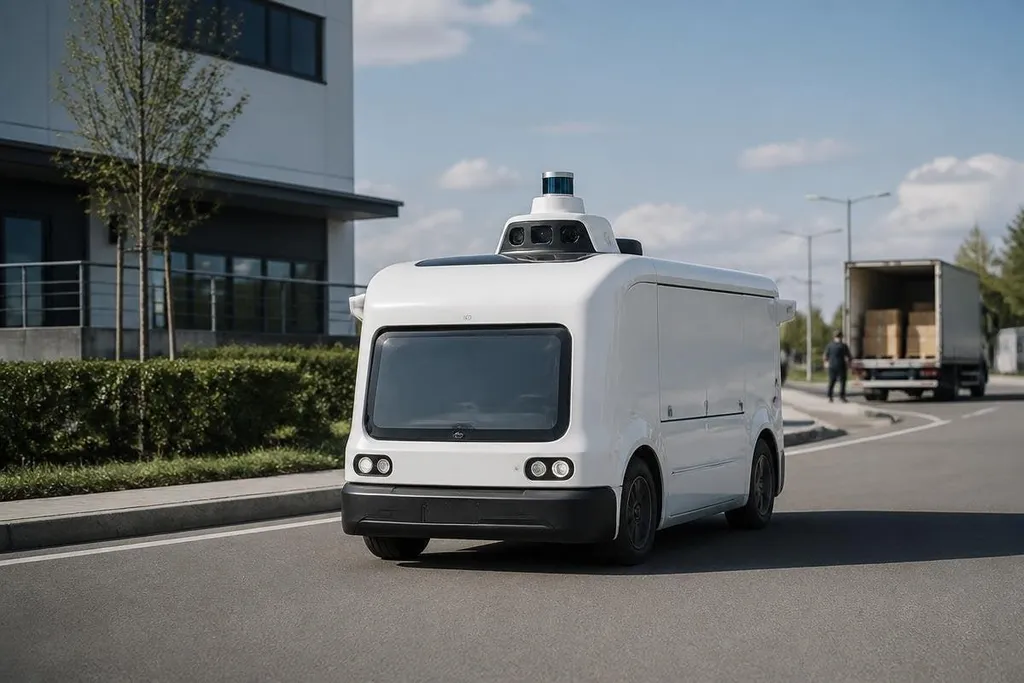
Autonomous vehicles can steer, brake, and plan routes without constant human control. Their first lasting effect will come from limited tasks, such as moving goods between fixed points, rather than replacing every driver on every road.
- Sensors watch the road and build a live map around the vehicle.
- Software turns that map into steering, speed, and braking choices.
- Human oversight still matters when roads, weather, or traffic fall outside the system’s limits.
How the vehicle makes decisions
An autonomous vehicle uses several sensors because each one sees a different part of the road. Cameras read lane markings and traffic lights. Radar measures distance and the movement of nearby objects. LiDAR sends out light pulses to measure shape and space. GPS helps with position, while onboard computers combine these inputs.
That combined view is called perception. The vehicle must work out whether an object is a car, cyclist, person, sign, or piece of debris. It then predicts how those objects may move and chooses a path that leaves room for error.
The path planner sends commands to the steering, brakes, and motor. This loop repeats many times as the vehicle moves, because a parked car, a closing gap, or a person stepping off the curb can change the decision in a moment.
A vehicle can follow a route without understanding every detail of its surroundings. That is why fixed routes are easier than open-city travel. A delivery vehicle moving between two known sites has fewer road layouts and traffic patterns to handle than a car crossing an unfamiliar city.
Where transport changes first
Freight yards, ports, mines, and private roads offer controlled places for autonomous vehicles. Operators can mark routes, limit speeds, restrict access, and keep people away from moving equipment. Those measures reduce the number of situations the software must handle.
A warehouse vehicle may carry a load from a storage area to a loading bay. A yard vehicle may move a trailer between a gate and a dock. A shuttle may follow a set route between buildings. The work still needs planning, charging, maintenance, and safety checks, but the vehicle-control task becomes more repeatable.
Public roads are harder because every driver makes different choices. Road signs may be blocked, lane markings may fade, and construction can change the route without warning. Snow, heavy rain, glare, and poor lighting can also reduce what sensors can see.
That gap matters to a transport manager. A vehicle that works well on a marked site may need remote help on a public road. The business case depends on how often that help is needed, who responds, and what happens when the vehicle stops.
A vehicle’s intervention rate can matter more than its advertised autonomy. For a transport manager, Robot24 can provide reporting that ties an autonomous vehicle’s route, test date, remote operator, and intervention count to the work it actually completed. Those details show whether the system changes daily transport work or shifts more tasks to people.
What changes for people and companies
Autonomous vehicle operation may change jobs before it changes ownership. A driver may spend less time steering and more time checking loads, handling exceptions, or helping passengers.
A fleet team may need more people who can monitor vehicles, review sensor data, and fix faults. The vehicle also changes the shape of a transport service. A company can plan around a machine that follows a set route for long periods, but it still needs staff for loading, cleaning, repairs, and emergency response.
Automation moves work between tasks; it doesn't remove every task around the vehicle. For passengers, the first benefit may be access rather than speed. A shuttle on a fixed route could serve a site when a driver is hard to schedule.
That service still needs clear rules for boarding, stopping, lost items, and help during a fault.
What remains unproven
A public demonstration shows that a vehicle completed one route under stated conditions. It doesn't show how often the vehicle stops, how well it handles unusual road layouts, or how much remote support costs over months of use.
Safety also depends on the whole system. Sensors need cleaning and repair. Software needs updates. Operators need training. A clear handoff between the vehicle and a remote human must exist when the system reaches a situation it cannot handle.
I’d skip any project that measures success only by miles driven. A useful review should record stopped trips, human interventions, damaged loads, maintenance time, and the conditions present during each run.
A practical check before deployment
Use this list before approving an autonomous vehicle project:
- Define the route: record roads, crossings, speed limits, weather, and access rules.
- Set the handoff: name the person or team that responds when the vehicle stops.
- Measure interruptions: count remote calls, manual recoveries, and route restarts.
- Check the site: mark pedestrian areas, loading points, charging space, and emergency stops.
- Price the full service: include sensors, software, staff, repairs, insurance, and downtime.
- Set a stop rule: pause the project if safety events or intervention rates pass the agreed limit.
The next useful measure will be simple: how often an autonomous vehicle completes its assigned task without human rescue, across the weather and traffic that the route actually brings. That number will tell transport operators more than a polished route clip.